

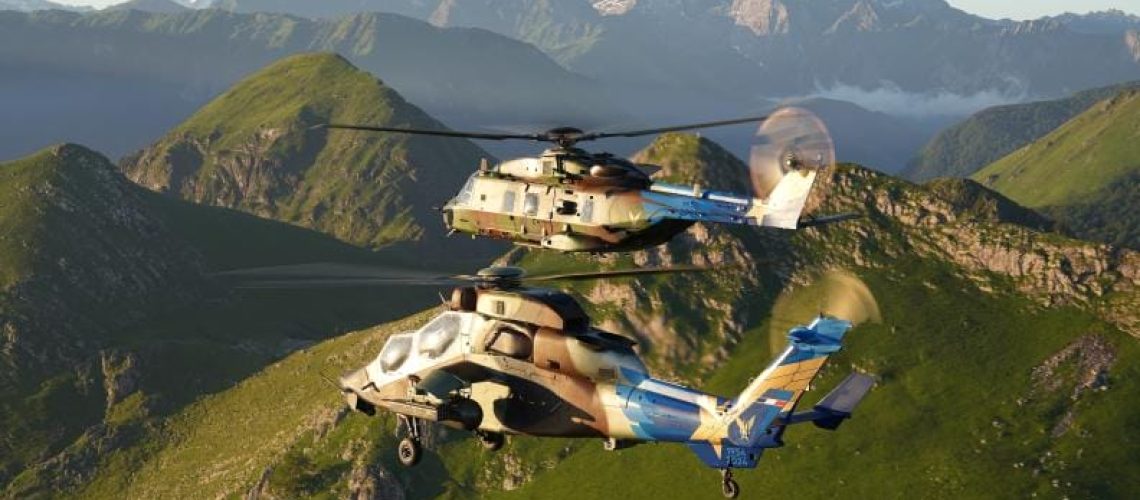
Photo: a Caiman in flight with a Tiger during the celebration of the French Army Aviation’s 70 year anniversary © French Army, https://www.defense.gouv.fr/terre/actualites/alat-70-ans-maitrise-airs-dinnovation-tactique
Assault helicopters, as they are generally referred to on anglo-saxon terminology and known as « Hélicoptères de manœuvre et d’assaut » (HMA) – – Maneuver and Assault helicopters » – in France, are best known as tactical mobility vehicles for carrying out their missions, namely troop transport, commando drops, exfiltration, medical evacuation (MEDEVAC), and resupply.
While these missions remain relevant and justify keeping a helicopter component within the armed forces (an ongoing debate among some of them), changes in the battlefield, threats, and technology have profoundly transformed this cornerstone of Air Mobility and the XXIst Century Air/Space Land Battle evolution.
From counterterrorism to the return of high-intensity warfare, from the proliferation of Man-Portable Air Defense Systems (MANPADS) to that of drones, through the return of advanced short-range air defense systems (SHORAD) and electronic warfare, helicopters can no longer operate as they did in the days of peacetime dividends or during the Cold War.
Under pressure from this new environment, armed forces over the world have upgraded their fleets, doctrines, and technologies. Even if. in many cases, this involves “only” upgrading existing airframes, XXIst-century aircraft tend to differ profoundly from their predecessors in terms of both systems and mission profiles. We are thus seeing a gradual transition from assault helicopters mainly used for transport to a “flying C2” (C2 for “Command & Control”) role, capable of synchronizing ground action in real time, relaying communications, integrating advanced sensors, and remotely piloting drones in order to operate in increasingly contested environments.
” “Even though C2 is not a new skill within air combat units, since it is this practice that has enabled us for many years to design, conduct, and coordinate our autonomous and/or in-depth operations. What is emerging now is the interest shown in it by combined arms units, up to brigade level. Indeed, the compatibility of communication systems between the ground and the third dimension (even close to the ground), the necessary acceleration of the decision-action cycle to recreate an element of surprise, the need for real-time coordination between the various components involved in an operation, and the high mobility of these command resources are a real asset, particularly for ground forces,
” recalls a former officer of the French Army Light Aviation (ALAT).
This is a trend that the governor of Metz, Lieutenant General Pierre Meyer, had anticipated in various public statements in recent years (1). In an interview given to Air & Cosmos during the last Eurosatory event, when he was still commander of the French Army Aviation in 2023, he explained: ” We are convinced that the French Army Aviation (ALAT) (…) will play a decisive role in the coming years. (…) Cooperation between drones and helicopters is fundamental. We can imagine ALAT infiltrating a complex maneuver flanked by drones, which can themselves multiply air combat capabilities. (…) We are talking about swarms of drones, remotely operated munitions, which can be launched from a helicopter (…). All these topics are on the table and (…) the challenge is connectivity, not only to be able to remotely pilot a drone, but also to be able to command, to have C2 on board and to be in tune with the future collaborative combat of the Scorpion modernization Army program » (2)
Two years later, this vision is well on its way to becoming a reality within many armed forces. This article provides a brief overview of this transformation, examining the evolution of missions and their adaptation to current threats in light of some of the modernization efforts already undertaken by allies (3).
Assault helicopters: different specifications, but similar doctrinal developments
Different Terminology (and capabilities), Common Missions
It is worth noting, to begin with, that assault helicopters have different capabilities depending on the armed forces, and highlighting some major semantic differences.
In Europe and the United States alone, one can find many such differences. For instance:
In France, the term HMA is used for the Caiman (NH90), the Cougar, the Caracal and, in some configurations, the future Guepard (H160M) (4).
In the United States, the terminology distinguishes between assault helicopters, such as the Black Hawk UH-60 and, eventually, its successor under the FLRAA (Future Long-Range Assault Aircraft) program, and heavy assault helicopters, such as the CH-53E Super Stallion and its successor, the CH-53K King Stallion for the Marines, as well as the CH-47F Chinook and its Block II for the Army, and the latest version, the MH-47G Chinook for special forces (5).
NATO indeed uses a similar terminology, referring to “Medium and Medium-Heavy Utility & Transport helicopters” (6).
In the United Kingdom, in addition to American aircraft, one can find the Royal Marines’ “Commando Helicopters” such as the AW101 Merlin HC4, as well as the Wildcat AH1 dedicated to the Army Air Corps, both of which are Anglo-Italian productions.
In Eastern Europe, the classification includes the Mi-17 and Mi-171Sh in the “assault/transport tactical helicopters” category .”
While the semantics differ significantly, this is a homogeneous functional category, less because of their specific characteristics – since it ranges from medium aircraft weighing 6 to 12 tons to heavy helicopters that can exceed 20 tons when loaded (and can approach 40 tons maximum takeoff weight in the case of the CH53K) -, but rather because of their CONOPS (Concept of Operation), which can be divided into five main categories: air (/space)-land maneuver, airborne assault, insertion and exfiltration in hostile territory, special forces support, and – increasingly – “frontline” logistics.
Mission expansion: From Tactical Lift To Real-Time Embedded C2 Capabilities
As a former French Army Aviation officer points out, MEDEVAC and logistics remain more relevant than ever, due to “the imperative to quickly return our often limited weapons systems to service: these depend on subsystems, the repair of which relies exclusively on industrial expertise and, as a result, always involves logistics flows over very long distances due to insufficient stocks and spares.”
This said, the core mission of assault helicopters remains, of course, airborne assault. Whether for French, British, or American special forces missions, or for insertions and extractions under threat, the ability to project troops as close as possible to the Point-of-Need – most of the time without being able to land – remains the raison d’être of these aircraft. However, the level of conditioning, guidance, and synchronization required has changed radically over the past two decades.
This evolution is particularly visible in the rise of missions involving special forces. More than ever, these require low-altitude night navigation, infiltration without landing, electronic coverage, and longer and longer range capabilities. The US Special Forces’ MH-47G Chinook is an illustration of such a trend, as it was designed specifically for insertion, exfiltration, and resupply missions in hostile territory, including without landing.
To meet range requirements, it has additional fuel tanks and a retractable in-flight refueling boom, giving it considerably greater autonomy than previous versions (7).
The Caracal helicopter used by the French Air and Space Force also enjoys a particularly valuable in-flight refueling capability.
When it comes to very low-altitude flight, the French ALAT, the US Army Aviation, and the US Marine Aviation share a common unique expertise—known as “tactical flight”—which is now enhanced by the introduction of new technologies such as multimode radars for terrain tracking and avoidance, as well as weather detection.
But the real doctrinal revolution lies in the emergence of a new role: that of “flying C2,” just like most flying platforms today.
Assault helicopters are indeed gradually becoming tactical command nodes capable of merging data – faster and faster – from multiple sensors (infrared, electro-optical, radar, drones), relay several communication networks (VHF, UHF, SATCOM, tactical data links—including L16 in receiving mode—, as well as battlefield management systems), and serve as relays.
This growing connectivity gives rotary-wing aircraft the ability to coordinate combined maneuvers—which has always been the DNA of the Army—including, today, with drones.
Synchronizing the actions of ground troops and maintaining command in a degraded environment can tip the balance on the battlefield, as the autonomy of this helicopter component could increase thanks to ongoing innovations.
Among the platforms that have undergone this type of evolution are, for example: the Caracal of the French special forces (Air and Space force and Army with the 4e RHFS), which has been incorporating on-board C2 capabilities enabling mission control and coordination in flight, including for night operations; the American MH-60M, which shares the avionics architecture of the MH-47G; the British AW101 Merlin, which has been optimized for amphibious C2, and the NH90, which, in SOF configuration, can be fitted with C2 mission kits.
Survivability and modernization: adapting to the contemporary battlefield
New threats and an increasingly contested environment
The modern tactical environment imposes new constraints that have definitively ended the era of transport benefiting from the protection of air dominance. Four categories of threats have become real game-changers for assault helicopters.
The proliferation of modern MANPADS is the first of these threats. Recent conflicts, particularly in Ukraine, have demonstrated the effectiveness of systems capable of engaging helicopters at increased ranges and equipped with improved counter-countermeasures. The significant losses of Russian helicopters bear witness to this reality (8). In response to this threat, infrared exhaust suppressors that reduce thermal signature can help protect the aircraft against infrared sensors and missiles.
The resurgence of increasingly sophisticated SHORAD (Short Range Air Defense) systems represents the second major development. Many mobile systems create “lethal bubbles” at low altitude, making the approach to assault zones considerably more dangerous (9).
Drones and loitering munitions constitute a third category of threats, which are particularly insidious. Helicopters are now threatened long before they reach the assault zone: ISR drones identify their trajectories, kamikaze drones track their weak points, and loitering munitions saturate their approaches. The Ukrainian conflict has provided abundant illustrations of this new reality (10).
Finally, the return of electronic warfare and GNSS (Global Navigation Satellite System) jamming are challenging the (relatively) guaranteed access to navigation and communications. The ability to navigate autonomously by tracking the terrain, even in the absence of a GPS signal, is therefore more imperative than ever in the current conditions.
Enhancing the survivability of assault helicopters also requires strengthening the lethal protection systems carried on board and the materials used in the construction of the aircraft, a trend that can be observed everywhere.
Towards a new era: the assault helicopter as the linchpin of Multi-Domain Operations
The evolution of assault helicopters is part of a general doctrinal convergence among allies, but this synergy faces persistent obstacles. Differences in radio systems, uneven SOF capabilities among nations, and differences in CONOPS complicate the desired interoperability. Complete harmonization remains a long-term goal.
Within the conceptual framework of MDO (Multi-Domain Operations) – M2MC in French for “Multi-milieux Multi-champs” (multi-environment multi-field) – assault helicopters are taking on a new importance as “cohesion nodes” between the various components of the battlefield.
Being able to connect ground forces, drones, long-range artillery, signals intelligence, and brigade command posts is a key factor in victory and superiority on the battlefield. This integration function, made possible by the data fusion and real-time communication relay capabilities of modernized aircraft, undoubtedly makes the assault helicopter a key element of joint maneuver warfare.
“The practice of combat flight close to the ground, day and night and between obstacles, as we do in the ALAT, as well as navigation using inertial navigation systems that are inherently independent of GPS signals, and close cooperation between drones and helicopters, which multiplies effects, are all means of adapting to these new threats. Innovation and the evolution of cutting-edge technologies are key elements in addressing these threats,” emphasizes a former French Army Aviation officer.
Far from signaling the obsolescence of traditional assault helicopters, the emergence of drones appears therefore to be particularly complementary. In the opinion of former French Army Aviation General Meyer, missions are naturally divided as follows: reconnaissance, laser target designation, flank protection during maneuvers (“flank guard”), and saturation upon contact are missions for which drones are better suited today than helicopters (11), which remain relevant for extraction, embedded C2, operational tempo management, and sensitive missions requiring a human presence.
The convergence of the Army’s use of drones and continuous advances in data fusion and connectivity seems, on the contrary, to further reinforce the importance of the helicopter as a platform for integration and coordination (12).
Increasingly polyvalent, assault helicopters are becoming multi-role, multi-sensor, connected platforms capable of providing tactical command on the front line. Extended range thanks to in-flight refueling and/or additional fuel tanks, improved stealth through infrared suppressors, advanced avionics enabling in particular low-altitude night flight, integrated defensive systems and embedded C2 capabilities…
All these features, which are found to varying degrees in allied modernization programs, outline the contours of the XXIst-century assault helicopter.
The convergence of doctrine among allies, modernization efforts, and operational pressure show that this transformation is here to stay. In an increasingly sophisticated Anti-Access /Area Denial (A2/AD) environment, where, every day, drones, air defense systems, and electronic warfare are redefining the rules of the game, these helicopters are an essential link in Air Mobility superiority and modern Air(/Space)-Land battle.
By Murielle Delaporte
Notes
(1) See General Meyer’s interviews in 2023 and 2024 :
Journal de l’Aviation : https: //www.journal-aviation.com/podcast-aviation/lavenir-de-lalat-est-dintervenir-dans-la-grande-profondeur-general-pierre-meyer-commandant-de-lalat-20240506.html
Paris Air Forum : https: //www.youtube.com/watch?v=zu7OCqm5WMs
Air et Cosmos : https://air-cosmos.com/article/perspectives-et-retour-d-experience-pour-l-alat-avec-le-general-de-division-meyer-de-l-armee-de-terre-64843
(2) General Meyer, Air et Cosmos video (16 :16), ibid
(3) See for instance:
NATO JAPCC, Enhancing NATO Helicopter Capability (2018) : https://www.japcc.org/white-papers/enhancing-natos-operational-helicopter-capability/
Istituto Affari Internazionali, European Defence Integration and Helicopter Capabilities (2017) : : https://www.iai.it/sites/default/files/quaderni_e_01.pdf
(4) See General Meyer,’s interview published by Air & Cosmos in 2023: « Hélicoptères de l’Armée de Terre : évolution et retour d’expérience, avec le Général Meyer de l’ALAT », ibid
(5) Cf : official doctrineof the US Army FM 3-04, Army Aviation (2020)
(6) See on this topic: NATO JAPCC, Enhancing NATO Helicopter Capability (2018) : https://www.japcc.org/white-papers/enhancing-natos-operational-helicopter-capability/
(7) See on this issue for example: https://www.militaryaerospace.com/sensors/article/55331965/boeing-special-operations-command-orders-mh-47g-special-forces-heavy-assault-helicopters-and-avionics
(8) RUSI, Preliminary Lessons in Conventional Warfighting from Russia’s Invasion of Ukraine (2022) : https://static.rusi.org/359-SR-Ukraine-Preliminary-Lessons-Feb-July-2022-web-final.pdf
(9) To go further on this issue:
https://missilethreat.csis.org/russia-nato-a2ad-environment/ https://www.csis.org/analysis/revitalizing-european-air-defense https://www.cna.org/reports/2023/04/Russian-Combat-Air-Strengths-and-Limitations.pdfht
tps://static.rusi.org/SR-Russian-Air-War-Ukraine-web-final.pdf
https://hcss.nl/wp-content/uploads/2021/12/Integrated-Air-and-Missile-Defense-HCSS-Dec-2021.pdf
(10) https://www.rusi.org/explore-our-research/publications/special-resources/preliminary-lessons-conventional-warfighting-russias-invasion-ukraine-february-july-2022
(11) General Meyer, Air & Cosmos, ibid.